The After Taste of AI Slop
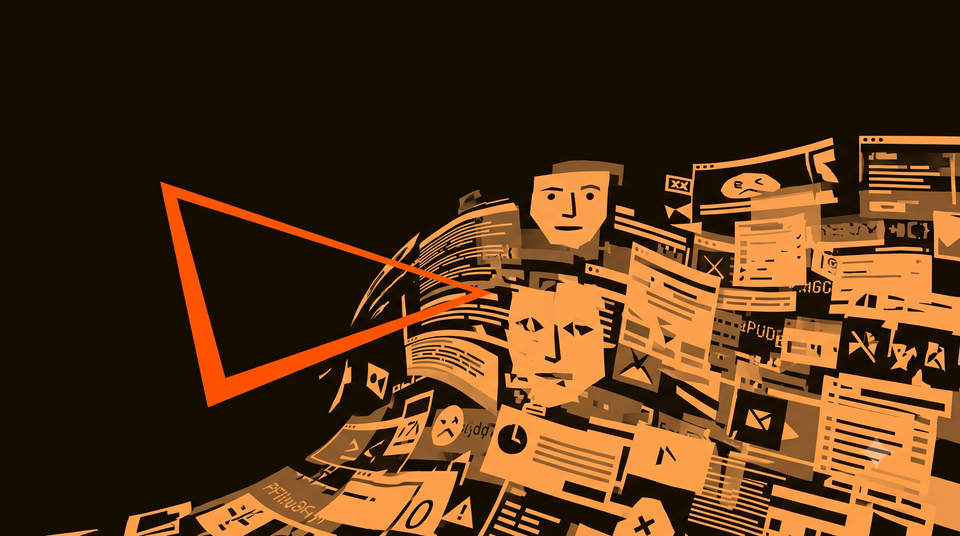
We have always shaped society through the stories we tell. AI is quietly rotting the foundation we tell them on and most people haven't noticed yet.
Human communication has always evolved with technology. Word of mouth gave way to the written word. Print gave way to radio. Radio gave way to broadcast television. And now we live and breathe digitally: faster, louder, and more interconnected than any generation before us. At each inflection point, communication shaped power: who the leaders were, what the rebellion printed, which message reached the masses first.
AI is the next inflection point. But unlike every shift that came before it, this one is actively making it harder to understand what is actually being communicated, and by whom.
The Trust Problem Nobody Is Fixing
When anyone with a laptop can generate a convincing video in minutes, four questions become nearly impossible to answer at a glance:
- Who actually made this?
- What is the real message and what is noise?
- Where does misinformation begin and end?
- Was this created in good faith, or to deceive?
These aren't hypothetical edge cases. They are happening right now, in political campaigns, in financial markets, in your social media feed.
Political AI Slop Is Already Weaponized
In the political arena, AI-generated video isn't just misinformation, it's a full-blown influence operation toolkit. We're seeing false advertising, fabricated statements, and adversarial actors producing content designed to look like it came from opposing campaigns. A deepfake video falsely depicting Zelenskyy's wife purchasing a luxury car during a Paris visit was shared by pro-Russian influencers and racked up nearly 18 million views within 24 hours.[1] Threat actors have also mimicked CNN's news format with AI-generated imagery designed to look like breaking news, fabricating scenes of real political figures in crisis.[2]
On the west coast, the 2026 Los Angeles mayoral race became a live case study.[3] Fan-made AI videos cast candidate Spencer Pratt as a Batman-like hero and incumbent Mayor Karen Bass as a villain, including a lightsaber duel with Governor Newsom scheming in the background. Pratt's campaign didn't make them. Supporters did. He reposted them anyway. As University of Pittsburgh professor Samuel Woolley put it: "At this point, the technology has become widespread, and nearly anyone can effectively create propaganda on behalf of a particular candidate."[3] Rival candidate Nithya Raman's campaign called it out directly: "Hollywood jobs are being devastated by AI. Meanwhile, Spencer Pratt is using his platform to promote AI-generated content, amplifying the very technology replacing the workers he claims to care about."[4]
These videos cast candidates as heroes or villains based on narratives the candidates never validated. When that content goes viral, it doesn't just add noise, it actively breaks the trust a political system depends on to function. Mark Jablonowski, CEO of progressive ad firm DSPolitical, said it plainly: "When you're creating content that is not based in reality, and then platforms are amplifying it in order to attract more eyeballs, you are putting a burden on the public for figuring out what is real and what is factual."[5]
Worth noting: a Knight First Amendment Institute analysis found that simple edits — not AI — were used seven times more often than deepfakes in the 2024 US election.[6] That doesn't make AI slop less dangerous. It means the misinformation problem is bigger than AI, and AI is accelerating it.
If AI-generated political content cannot be contained, validated, or publicly attributed, those who don't know any better will keep getting scammed by it.
Even the "Harmless" Stuff Is Training You Wrong
Cute AI animal videos. Clips of events that never happened. Heartwarming moments manufactured in a model's latent space. These seem low-stakes — but they're doing something insidious to your instincts. An AI-generated video of bunnies bouncing on a trampoline, framed as real doorbell camera footage, amassed over 200 million TikTok views before being identified as fabricated.[7] A peer-reviewed study in Conservation Biology found that AI wildlife videos frequently present distorted portrayals of nature, spreading misinformation especially among children and audiences with limited ecological knowledge.[8] Researchers have also found that AI videos portraying wild animals as pets can fuel demand for exotic pets, directly feeding the illegal wildlife trade.[9]
Every time you watch one of these videos and feel that small flutter of delight at something that isn't real, your brain updates. It becomes a little faster to trust the next one. A little slower to question.
AI crypto and investment content takes that same mechanism and aims it directly at your wallet. A deepfake Elon Musk crypto giveaway stream netted scammers at least $5 million from victims in under a year.[10] Global crypto fraud surged 456% between May 2024 and April 2025, with AI deepfakes driving roughly 40% of high-value crypto scams, approximately $4.6 billion in total losses.[10] The World Economic Forum documented a case where a Hong Kong finance worker wired $25 million after a Zoom call in which every participant, including the CFO, was a deepfake.[11] The financial world gets depicted as somewhere it isn't: certain, accessible, full of obvious winners, and trust is built on nothing. The scams that follow aren't bugs. They're the whole point.
Then there's the category I'd argue is most dangerous of all: AI-generated informational content on specific topics: cars, technology, health, current events. Brightly colored. Confidently narrated. Algorithmically optimized to make you stop scrolling. Misinformation wrapped in production value that screams absorb me. The content isn't just wrong; it's designed to feel authoritative.
We Are What We Consume
Think of it like diet. One processed meal won't kill you. But a slow, steady diet of it degrades your baseline, your energy, your clarity, your capacity to function well. AI slop works the same way on your knowledge baseline. Even if only a fraction of what you consume is fabricated, it contaminates everything around it. You start to second-guess real sources. You stop verifying. You follow, because following is what the content trained you to do.
It has also made us worse at actually talking to each other. These videos shift beliefs quietly, invisibly, without inviting the kind of conversation that would surface the controversy. Nobody argues about a video they didn't know was fake. Nobody demands accountability from a creator they can't identify.
The era of critical thinkers is under threat; not from a single bad actor, but from a content ecosystem that rewards passivity and punishes skepticism.
What Comes Next Is Our Choice
This isn't a call for panic. It's a call for awareness, the thing the cybersecurity community has always understood better than most. You cannot defend what you cannot see. And right now, a significant portion of the public cannot see what AI slop is doing to their information environment.
That means media literacy needs to be treated like a security control. Provenance: knowing where content came from needs to be a standard, not a luxury. And the platforms distributing this content need to be held to the same standards we'd apply to any infrastructure that touches public safety.
The after taste of AI slop lingers. The question is whether we decide to do something about it before we forget what the real thing tasted like.
Sources
- Global Taiwan Institute — "The Malicious Exploitation of Deepfake Technology," May 2025. globaltaiwan.org
- Centre for Emerging Technology and Security, The Alan Turing Institute — "Deepfake Scams and Poisoned Chatbots," November 2025. cetas.turing.ac.uk
- NBC News — "Spencer Pratt Los Angeles Mayoral Campaign AI Videos," May 2026. nbcnews.com
- FOX 11 Los Angeles — "Spencer Pratt's Viral AI Campaign Ads Spark Buzz," May 2026. foxla.com
- GovTech / Tribune News Service — "AI-Generated Videos Have Invaded the L.A. Mayoral Race," May 2026. govtech.com
- Knight First Amendment Institute, Columbia University — "We Looked at 78 Election Deepfakes," December 2024. knightcolumbia.org
- 404Media / The Outpost AI — "AI-Generated Animal Videos Fool Millions," August 2025. theoutpost.ai
- Conservation Biology (Guerrero-Casado et al.), summarized by A-Z Animals — "How AI-Generated Animal Videos Mislead Millions About Nature," November 2025. a-z-animals.com
- The Wildlife Society — "Q&A: AI Videos Reveal Seeing Should Not Be Believing," February 2026. wildlife.org
- Yellow.com Research — "Top 10 AI-Powered Crypto Scams of 2025," December 2025. yellow.com
- World Economic Forum — "Deepfakes: A Different Threat Than Expected," January 2025. weforum.org


Member discussion